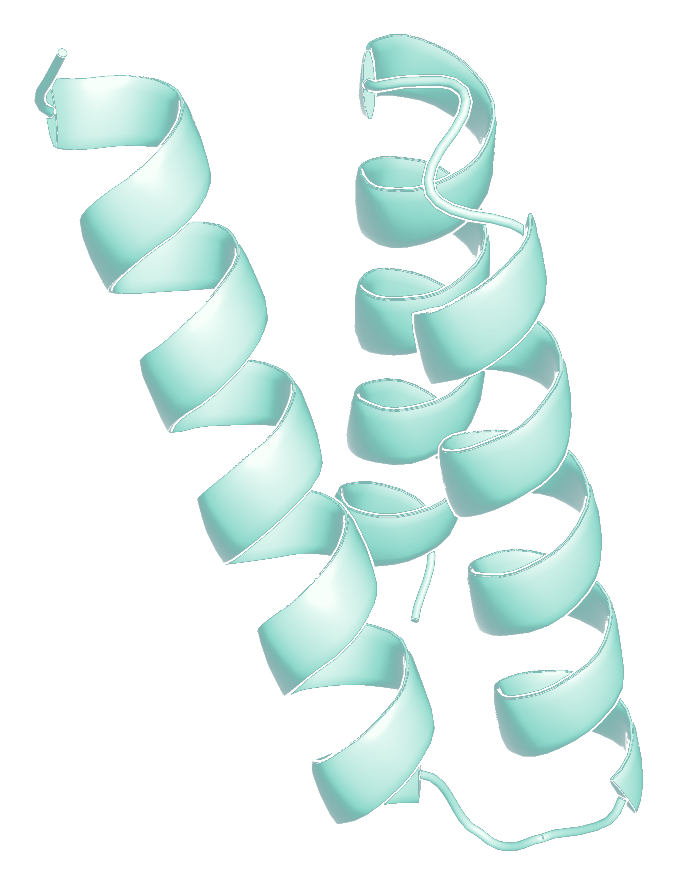
AI-guided molecular design
Generative models, structure prediction, and experimentally grounded learning for antibodies, nanobodies, miniproteins, and other recognition modules.
We combine artificial intelligence, structural biology, and high-throughput experimentation to engineer vaccines, therapeutics, and programmable biomolecular systems.
Our mission
Biology provides powerful molecular machines, but evolution did not optimize them for every challenge in human health. Our lab develops computational and experimental methods to understand how proteins work—and to redesign them with new structures, interactions, and functions.
Research platform
Our work spans foundational method development and translational applications. Every program connects predictive modeling to experimental measurement.
Generative models, structure prediction, and experimentally grounded learning for antibodies, nanobodies, miniproteins, and other recognition modules.
Structure-guided immunogens that stabilize vulnerable viral proteins, reshape immunodominance, and expand protection across viral diversity.
De novo scaffolds, symmetric complexes, and nanoparticles that organize viral antigens or create new delivery and biomaterials functions.
Yeast display, pooled libraries, pseudovirus systems, affinity and stability selection, and NGS readouts that turn experiments into better models.
Featured programs
Selected programs illustrate how the lab connects algorithm development, molecular engineering, and translational biology.
An experimentally grounded platform for designing antibodies, nanobodies, and miniproteins through closed-loop learning.
Project overview →Modular hemagglutinin design to understand and redirect antibody responses toward conserved protective surfaces.
Learn more →General computational strategies for preserving vulnerable prefusion conformations as vaccine and structural biology reagents.
Related publications →Precisely shaped assemblies that control antigen geometry and create new platforms for delivery and biomolecular materials.
Learn more →How we work
We use experimental outcomes—including failures—to improve design decisions and generate reusable scientific knowledge.
Identify a biological mechanism, structural constraint, or translational need.
Generate structures and sequences using physics-based and AI methods.
Synthesize focused designs or diverse pooled libraries.
Measure expression, stability, binding, structure, immunity, and function.
Integrate results into the next design cycle and open computational resources.
Work with us
We welcome researchers who want to work across computational design, structural biology, virology, immunology, and high-throughput experimentation.
Based at WashU Medicine
Division of Infectious Diseases, with affiliations across Molecular Microbiology and Biochemistry & Molecular Biophysics.